
How D2C Brands Are Growing in 2026: Strategies, Technology & AI
The way people discover, evaluate, and purchase products has changed dramatically.
A few years ago, building a consumer brand usually meant depending heavily on distributors, wholesalers, retail stores, and large marketplaces. Today, a small business can launch a product online, build an audience on social media, sell directly through its website, collect customer data, personalize the shopping experience, and scale across multiple markets.
This is where D2C brands come into the picture.
D2C, or Direct-to-Consumer, is a business model where brands sell products directly to customers without depending entirely on traditional intermediaries.
But D2C is no longer simply about having an online store.
In 2026, successful D2C brands are combining eCommerce, content, data, automation, AI, customer experience, logistics, and technology to build stronger relationships with customers.
What Is a D2C Brand?
A Direct-to-Consumer brand sells its products directly to the end customer, generally through channels such as:
- Brand-owned websites
- Mobile applications
- Social commerce
- Marketplaces
- Social media
- WhatsApp and messaging channels
- Offline experience centers
The major difference is the relationship between the brand and the customer.
In a traditional model:
Manufacturer → Distributor → Retailer → Customer
In a D2C model:
Brand → Customer
This doesn't mean D2C brands completely avoid marketplaces or retailers. Instead, the brand attempts to maintain greater control over the customer relationship, branding, experience, and first-party data.
Why Are D2C Brands Becoming So Popular?
One of the biggest advantages of the D2C model is control.
A brand can control how its product is presented, how customers interact with it, how feedback is collected, and how marketing campaigns are optimized.
Traditional Brand Model
Area | Traditional Model |
|---|---|
Customer relationship | Often indirect |
Product presentation | Retailer controlled |
Customer data | Limited |
Marketing | Broad campaigns |
Feedback | Slower |
Personalization | Limited |
D2C Model
Area | D2C Approach |
|---|---|
Customer relationship | Direct |
Product presentation | Brand controlled |
Customer data | First-party data |
Marketing | Highly targeted |
Feedback | Faster |
Personalization | Advanced |
This creates an important advantage: the brand can learn directly from its customers.
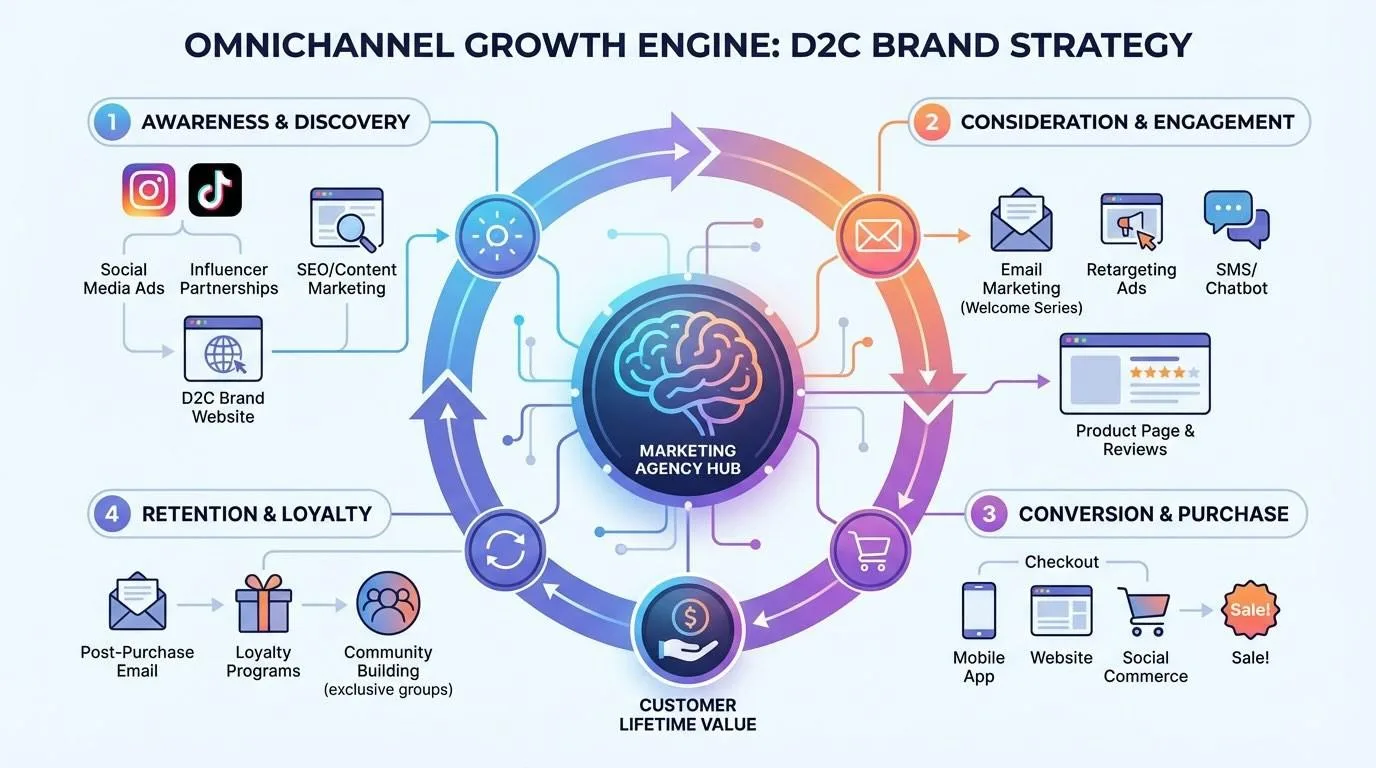
The D2C Growth Journey
Building a D2C brand is not simply about launching a Shopify store or running Instagram advertisements.
The journey usually looks something like this:
Product → Audience → Content → Acquisition → Conversion → Delivery → Experience → Retention → Advocacy
Every stage creates an opportunity for optimization.
For example, imagine a skincare brand.
A potential customer sees an Instagram video explaining a skincare problem.
They visit the brand's website.
The website recommends suitable products.
The customer purchases.
After the purchase, the brand sends educational content and personalized recommendations.
Eventually, the customer purchases again and recommends the brand to friends.
The brand has effectively created a customer lifecycle, rather than simply completing one transaction.
1. Strong Brand Identity Is Becoming More Important
Thousands of products compete for attention online.
A D2C brand therefore needs more than a good product.
It needs a recognizable identity.
This includes:
- Brand positioning
- Visual identity
- Packaging
- Website design
- Tone of communication
- Social media presence
- Product storytelling
- Customer experience
A strong D2C brand answers one simple question:
Why should customers choose us instead of the alternatives?
Price alone is rarely a sustainable answer.
Successful brands increasingly compete through trust, experience, community, quality, convenience, and differentiation.
What Makes a D2C Brand Successful?
There isn't one formula that guarantees success.
However, strong D2C brands typically focus on several common areas:
1. Product
The product must solve a real problem or provide meaningful value.
2. Positioning
Customers should quickly understand what makes the brand different.
3. Customer Experience
Every interaction should feel simple and trustworthy.
4. Data
Business decisions should increasingly be based on measurable customer behavior.
5. Technology
Technology should remove friction and improve scalability.
6. Retention
Acquiring a customer is only the beginning.
7. Community
Strong brands create customers who become advocates.
The Future of D2C Brands
The next phase of D2C is likely to be less about simply selling products online and more about building intelligent customer ecosystems.
A future D2C experience could look like this:
Customer discovers brand
↓
AI understands customer intent
↓
Personalized products are recommended
↓
Customer purchases through a seamless experience
↓
Automated fulfillment begins
↓
AI-powered support assists the customer
↓
Customer receives personalized recommendations
↓
Brand predicts the next purchase
This creates a continuous relationship between the customer and the brand.
The biggest opportunity for D2C companies is therefore not just selling more products.
It is understanding customers better and using technology to serve them better.
Final Thoughts
D2C brands have changed the traditional relationship between businesses and customers.
But the D2C model itself is also evolving.
The next generation of successful brands will combine:
Strong products + powerful branding + excellent customer experience + data + AI + technology + retention.
Businesses that treat technology as only a website-building tool may struggle to keep up.
Businesses that use technology to understand customers, automate repetitive work, improve operations, personalize experiences, and make smarter decisions can create a much stronger foundation for long-term growth.
For D2C brands, the future isn't simply digital commerce.
It is intelligent commerce.
Frequently asked questions
What does D2C mean?
D2C stands for Direct-to-Consumer. It refers to a business model where brands sell products directly to customers rather than relying entirely on traditional distributors and retailers.
What are the advantages of a D2C business model?
Major advantages include greater control over branding, direct customer relationships, access to first-party customer data, faster feedback, personalized experiences, and more control over the buying journey.
How can D2C brands grow?
D2C brands can grow through strong products, SEO, content marketing, social media, paid advertising, customer retention, personalization, technology, automation, and AI.

About Krishna Tiwari
I help aspiring developers and tech professionals turn ideas into real-world products through practical guidance in development, AI, backend, cloud, and system architecture. I can mentor you through technical challenges, project building, career growth, and choosing the right technologies to build scalable solutions.
More articles by this author →